
By Emily Volmar, Land Stewardship Coordinator
If you’re anything like me, you love a good walk in the woods on one of the first warm spring days of the year. Lately, I’ve made it a practice to slow down and listen — to notice what’s around me: a stream babbling over stones, animal prints on the ground, the age etched into the bark of surrounding trees.
This appreciation has been dubbed the “art of noticing,” inspired by a book of the same name by Rob Walker. Observing everyday beauty has not only been mindfully grounding, it’s also deepened my understanding of the plants and animals we share this space with.
Spring is just around the corner and, luckily for us, is the perfect time to start practicing the art of noticing. It may seem grey and bleak at first glance (especially if this snow doesn’t let up), but look a little closer — life is already stirring.
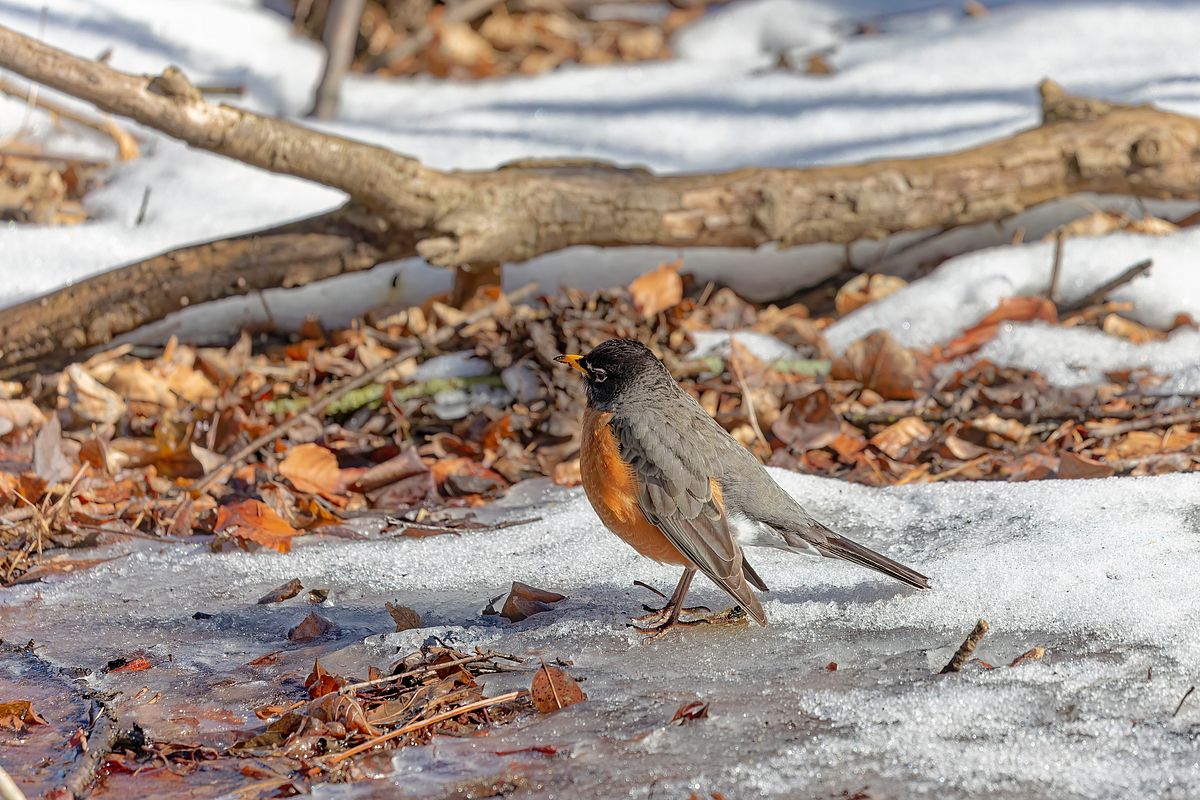
For some, the first sign of spring is the call of migratory birds. By mid-March, you might hear the Eastern Phoebe singing its name or the familiar song of the American Robin in your backyard. This year’s true New England winter may delay their arrival, but surely, they’re on their way.
When birds arrive, access to their prey (insects) is critical. While the sound of birdsong may win out over the whirring buzz of wings, insects are just as vital to the season’s unfolding. As the soil begins to thaw and worms writhe beneath the surface, small pools of melted snow become ideal breeding grounds for many flying species. Around the same time tree buds begin to swell, insects begin to move. Take a moment to look closely — you may spot them before you hear them.
Even before the snow fully disappears, vernal pools are beginning their busiest season. Some salamanders are already on the move, among the first to leave spermatophores and eggs in these temporary wetlands. Frogs, too, begin to leave their jelly-like egg masses in vernal pools.
If you find vernal pools as fascinating as we do, you’re in luck. On Monday, March 16th, from 7:00 - 8:30pm, Mount Grace is hosting a vernal pool talk with Scott Jackson, a UMass Extension professor that specializes in wetland ecology and amphibians. If you’re interested, you can sign up for free here.
Document What You See
As you begin to observe the world around you more closely, I invite you to document what you see. For some, that might mean jotting notes in a journal; for others, it may be snapping a photo or recording a quick thought on your phone.
One great tool you can use to become a more active participant in noticing what’s around you is iNaturalist. Otherwise known as “iNat”, this identification software allows users to upload nature observations to a broader community of naturalists and nature enthusiasts. Once an observation’s identification is confirmed by enough people, it becomes “research grade” and can be used to inform scientific studies. Disagree with another user’s identification? You can suggest something else. If you’re just starting out, this community collaboration can be especially helpful if you’re not sure of your findings. This type of active learning is the perfect way to familiarize yourself with trees, animals, insects, etc. that you come across during a springtime walk.
This spring, Mount Grace will be holding a BioBlitz for the City Nature Challenge – an international iNaturalist event that invites participants to record as many observations and identifications as possible. It will be held on April 25th, with birding in the morning and botany in the afternoon. This event will be at our newly protected conservation area in Orange, MA- Eagleville Barrens. Keep a lookout on our website for more information.
Next time there’s a warm spring day, take a moment to pause and look around. You may notice more than you expect.